
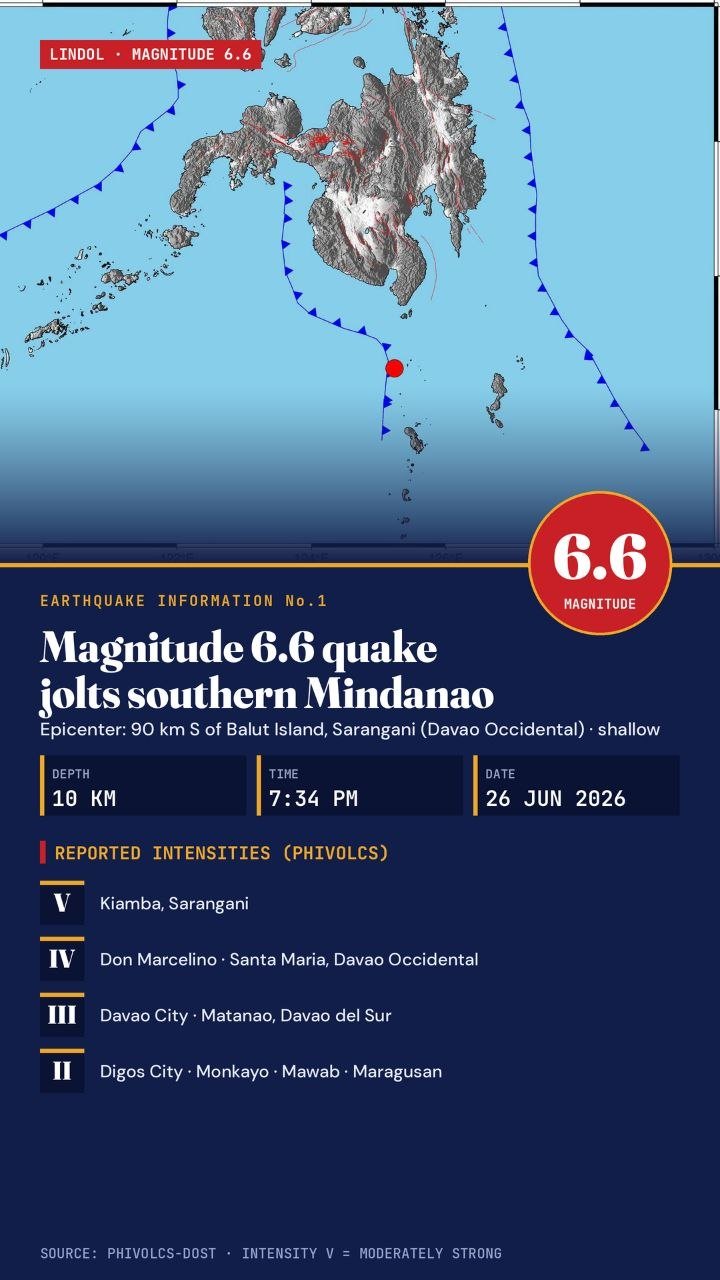
Southern Mindanao experienced strong ground shaking late Friday evening, June 26, after a magnitude 6.6 earthquake struck the waters south of Davao Occidental, according to the Philippine Institute of Volcanology and Seismology (PHIVOLCS). The event prompted an immediate bulletin from the agency as residents across several provinces reported feeling the tremor.
Earthquake Details and Location
PHIVOLCS reported that the earthquake occurred at 7:34 in the evening and was traced to a point 90 kilometers south and 12 degrees west of Balut Island, located within the island municipality of Sarangani in Davao Occidental. The coordinates were recorded at 4.62 degrees north latitude and 125.24 degrees east longitude.
The agency noted that the quake registered a shallow focal depth of only 10 kilometers, classifying it as tectonic in origin. Shallow earthquakes of this nature tend to produce stronger surface shaking compared to deeper seismic events, which explains the wide geographic spread of reported intensities across southern Mindanao.
Reported Shaking Intensities Across Provinces
Based on PHIVOLCS data, the strongest shaking reported by residents was Intensity V, recorded in Kiamba, Sarangani. This level of intensity is generally described as strong enough to be felt by nearly everyone, causing some objects to fall and minor damage to weaker structures.
Intensity IV shaking was reported in Don Marcelino and Santa Maria, both in Davao Occidental. Davao City and Matanao in Davao del Sur each registered Intensity III, while the City of Digos in Davao del Sur reported Intensity II. Also logging Intensity II were the municipalities of Monkayo, Mawab, and Maragusan in Davao de Oro.
Instrumental Intensity Readings
Beyond the felt reports from the public, PHIVOLCS seismographs captured additional instrumental intensity data across a broader range of locations. The highest instrumental reading reached Intensity V in two areas: Malapatan in Sarangani and T’boli in South Cotabato.
Instrumental Intensity IV was recorded in several Sarangani municipalities, namely Malungon, Maitum, Kiamba, and Maasim, as well as in Tupi and the City of Koronadal in South Cotabato. These readings indicate moderately strong ground motion that, while unlikely to cause major structural damage to well-built structures, may affect older or poorly constructed buildings.
Instrumental Intensity III readings were logged in Santa Maria, Davao Occidental; Tampakan, South Cotabato; and Palimbang, Sultan Kudarat. PHIVOLCS further recorded Intensity II and I readings in a wide swath of communities, including Magsaysay in Davao del Sur; Norala, Banga, Santo Niño, and Surallah in South Cotabato; Lebak, Isulan, Kalamansig, and President Quirino in Sultan Kudarat; Magpet, M’lang, and President Roxas in Cotabato; and Columbio and Esperanza in Sultan Kudarat.
Aftershocks Expected; Public Urged to Stay Alert
PHIVOLCS advised the public to anticipate aftershocks following the main earthquake. Residents in areas that experienced perceptible shaking are encouraged to remain vigilant and to carefully inspect their homes, offices, and other structures for any signs of cracks, wall damage, or structural compromise that may have resulted from the quake.
The bulletin was released as Earthquake Information No. 1 under PHIVOLCS monitoring protocols. The agency indicated that updated information and revised figures may follow as its monitoring teams continue to assess the event and gather additional data from its network of seismological stations across the region.
Background: Seismic Activity in Southern Mindanao
Southern Mindanao lies within one of the more seismically active zones in the Philippines, situated near several major fault systems and tectonic plate boundaries in the southwestern Pacific. The region has historically experienced frequent moderate to strong earthquakes, making public awareness and preparedness a continuing priority for local government units and national agencies alike.
PHIVOLCS regularly monitors seismic activity nationwide and issues public bulletins to keep communities informed about earthquake occurrences, intensity distributions, and safety recommendations. The institute operates a network of seismograph stations across the country to detect and measure ground motion as quickly and accurately as possible after a seismic event.
Authorities have not yet released official reports of casualties or major structural damage as of the time this bulletin was issued, though assessments are ongoing in areas that experienced the highest intensity levels.
Originally reported by: Philippine Institute of Volcanology and Seismology (PHIVOLCS)